


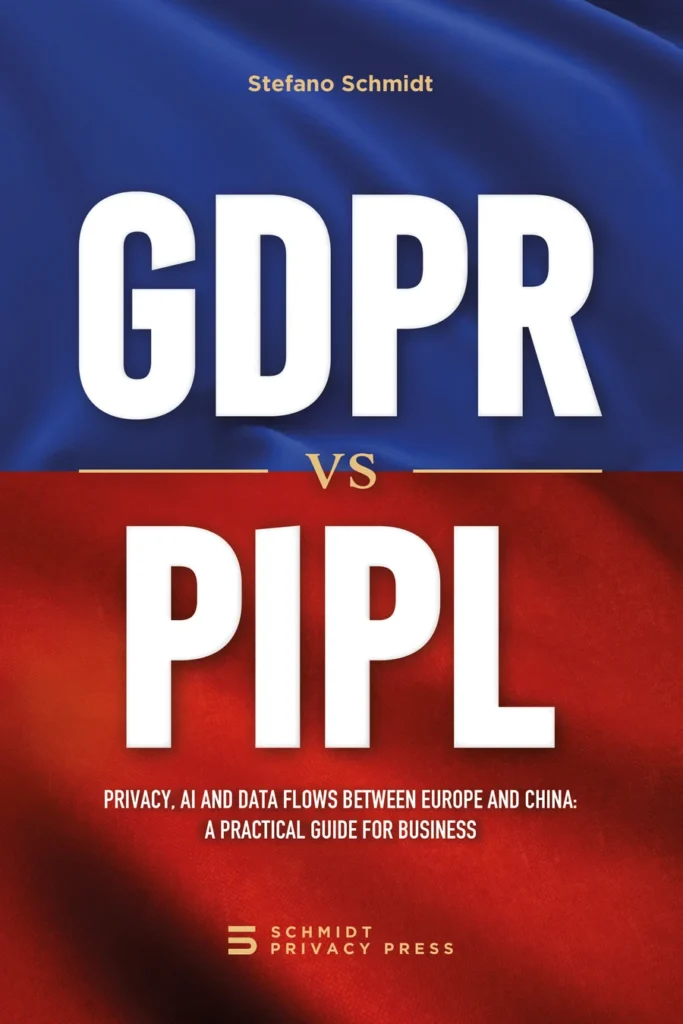
The book
The European GDPR and the Chinese PIPL use similar words, but they come from different philosophies and sometimes impose incompatible obligations. For a company that sells, manufactures, invests or buys in China, or for a Chinese company operating in Europe, the risk is not only breaching one of the two laws: it is complying with one while breaching the other.
Take one example. In Europe, the data of a customer’s contact persons is normally processed on the basis of legitimate interest; in China, legitimate interest does not exist. In Europe, storing European customers’ data in China requires an assessment of the risk of access by public authorities; in China, exporting “important data” without the approval of the cyberspace authority is prohibited.
This book trains the reader to look at every situation from both sides. It compares the two laws topic by topic, explains how data is transferred in both directions, including China’s 2024 simplifications, and applies everything to nine real business situations, each with a typical scenario, the obligations on both sides, common mistakes and key takeaways.
It does not assume a legal background, but it never gives up on precision: every rule comes with its legal references, and every reference is translated into practical consequences for the business.
Who it is for
- Business owners and managers of European companies that sell, manufacture or invest in China
- Chinese companies, or companies led by Europeans, operating in the European market
- Consultants, lawyers, DPOs and compliance officers who advise them
- Funds and advisors working on investments and acquisitions between Europe and China
What you will find
- A comparison of the GDPR and the PIPL: scope, legal bases and separate consent, sensitive data and minors, rights, roles, security, automated decision-making, enforcement and penalties
- Data transfers from Europe to China and from China to Europe, including the exemptions and thresholds introduced in 2024
- Data localisation, important data and conflicts between the two laws
- Nine business situations: B2B and B2C sales, marketplaces, subsidiaries and joint ventures, human resources, Chinese companies in Europe, acquisitions, suppliers and cloud, use of Chinese AI
- A map of the other rules to know: the AI Act, Data Act, NIS2, Digital Services Act and China’s rules on algorithms and generative AI
- Four appendices: comparative table, Italian–English–Chinese glossary, regulatory timeline and official sources
Structure
- Part I – Two worlds, two philosophies (chapters 1–4)
- Part II – The comparison (chapters 5–12)
- Part III – Data on the move (chapters 13–16)
- Part IV – Business situations (chapters 17–25)
- Part V – The wider framework (chapters 26–27)
- Appendices A–D: reference tools